- Healthcare · AI
- 2026 – now
- Founder
Parahealth
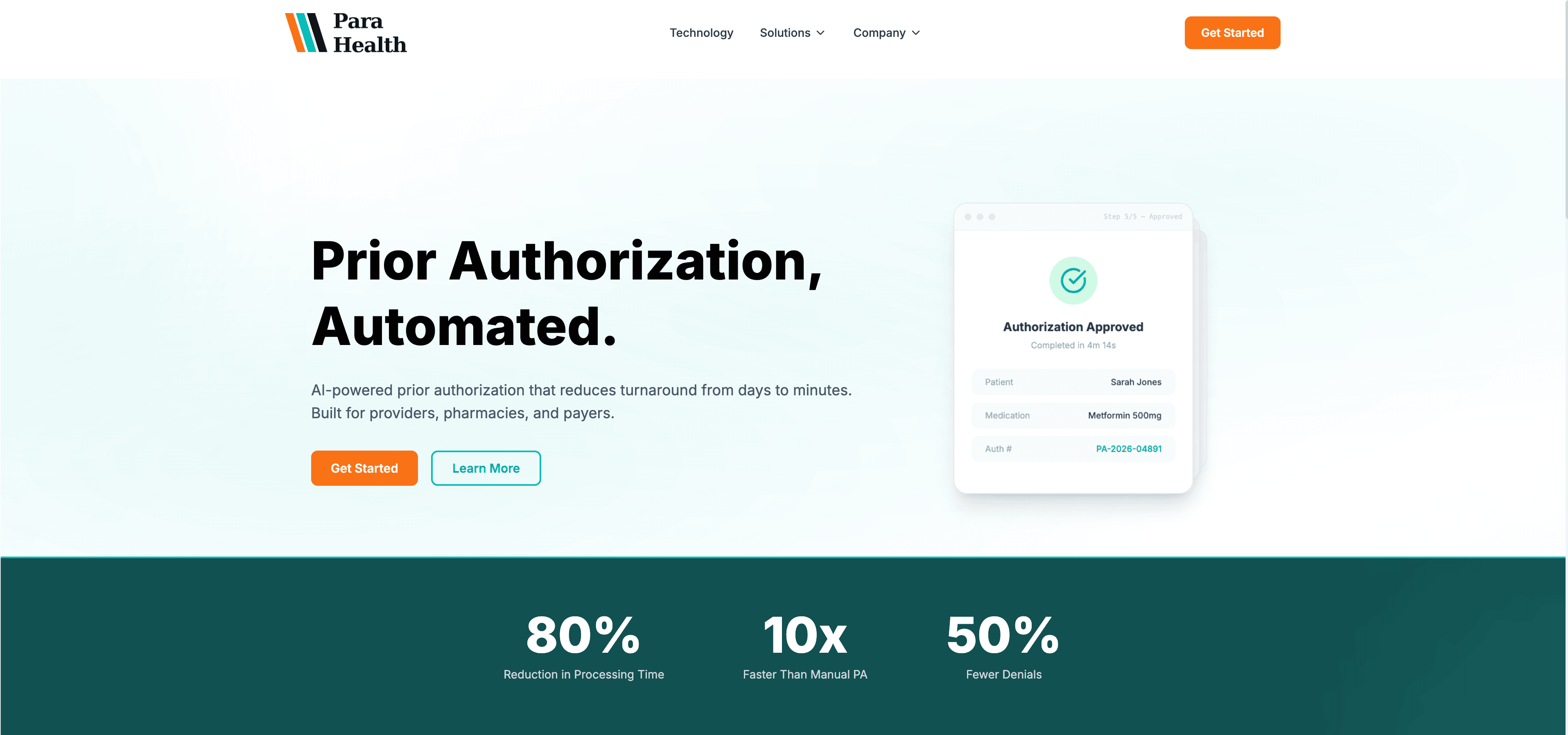
ParaHealth automates prior authorizations for prescription drugs, the hated, hours-per-patient paperwork pharmacy techs and clinic staff fight through for every script. A user uploads the patient's chart and picks the drug and payer. The product decides whether a PA is even required, verifies benefits with an automated AI phone call to the insurer, generates a completed payer-specific authorization in under five minutes with a confidence score on every answer, flags denial risk before it goes out, submits through whatever channel the payer accepts, and auto-drafts the appeal if it's denied. I designed and built the whole thing solo: frontend, backend, and the AI pipeline.
Problem
Prior authorization is one of the most hated workflows in healthcare. For every prescription that needs one, pharmacy techs and clinic staff spend 15–45 minutes per patient: figuring out whether a PA is even required, calling the insurer to verify benefits, hunting data scattered across the chart to fill a payer-specific form, faxing it in, and drafting an appeal when it's denied.
It's the single biggest source of staff burnout and a leading reason prescriptions get abandoned at the counter, and it's almost all repetitive, undifferentiated work. Across 50+ interviews with pharmacists and providers, the same story came back every time, and several asked when they could start using what I was building.
What I built
An end-to-end product that takes a pharmacy or clinic from prescription to a submitted, payer-ready PA. It ingests chart context, determines payer-specific requirements, generates the completed authorization with a confidence score on each answer, flags denial risk before submission, submits through fax, electronic, or phone, and auto-generates the appeal letter if the PA is denied.
Benefit verification runs as an automated AI phone call that dials the payer and works through their phone tree, replacing the hold-music-and-clipboard step.
I wrote every line myself: the React/Next.js reviewer UI, a FastAPI backend, the multi-model AI pipeline, and the payer and EHR integrations, all on PHI-handling, HIPAA-aligned infrastructure.
Architecture
A multi-model AI pipeline does the clinical heavy lifting, each model matched to the cost and quality envelope of its task. Anthropic's Claude Sonnet generates PA answers from the chart, Opus handles appeal letters and complex clinical reasoning, and Haiku classifies incoming documents.
Every answer carries a confidence score. High-confidence fields are auto-filled. Where the clinical notes don't clearly support an answer, the system surfaces it for human review rather than guessing, and the whole PA is scored for denial risk before it's ever submitted.
Because it handles PHI, it's built for a regulated environment from the ground up: field-level encryption (Postgres + pgcrypto) on AWS RDS, S3 with SSE-KMS, immutable audit logs, role-based access control, and HIPAA-eligible AWS infrastructure, with SOC 2 underway. Integrations span Sinch (fax), Bland (AI voice for benefit-verification calls), Epic FHIR, and Resend.
Stack
Outcomes
- Generates a completed, payer-ready prior authorization in under five minutes, down from the 15–45 minutes a tech spends today, a result that has held across different patient profiles and messy real-world note quality.
- On a real 166-question GLP-1 PA form (Zepbound), answers the form end-to-end against real de-identified patient records, with answer accuracy above 90% on high-confidence fields and low-evidence questions correctly routed to human review.
- Working product, built solo and validated through 50+ pharmacist and provider interviews, targeting a large, underserved wedge (roughly 180M prior authorizations submitted in the US each year).